
Article provided by Oficina de Turismo Utrera
Located 30 km from Seville and served by a direct train which takes around 25 mintues, Utrera is considered to be the birthplace of bullfighting and flamenco. But that is not the sole reason it deserves a visit. Its narrow streets, white-washed houses, palaces, churches, gastronomy, and the unique character of its people make visitors feel right at home.
Best time to visit Utrera
Utrera is a perfect place to visit at any time of the year, but there are two highlights in our calendar, which have been declared of “special touristic interest”.
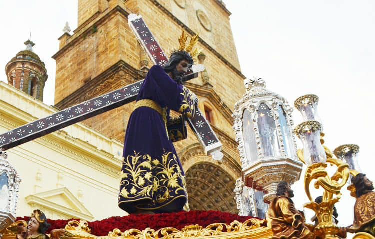
Holy Week in Utrera
One of the most striking moments takes place on Holy Thursday in the Church of Santiago, from which two brotherhoods depart: the Brotherhood of Silence—penitent, solemn, with chains… and the Brotherhood of the Gypsies—singing, exuberance, richness… making our Holy Week full of striking contrasts.
The Consolación Fair of Utrera
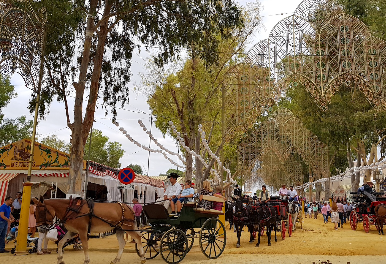
Considered the second most important fair in Andalusia after Seville’s, this takes place during the first week of September. If you want to experience an Andalusian fair with flamenco, guitars, singing from the heart, and horse-drawn carriages everywhere you look, this is the fair for you.
Other dates to visit Utrera:
Epiphany Parade, 5 January.
Carnival, in February.
María Auxiliadora Festivity, around 24 May.
Potaje Gitano Flamenco Festival (the oldest in Spain), held on the last Saturday of June.
Things to see and do in Utrera
Utrera is worth exploring at a leisurely pace. Apart from just soaking up the atmosphere, there are plenty of things to see that should not be missed.
Utrera Castle
The castle of Utrera is strategically situated on a natural hill surrounded by a ring of walls, the main means of defending the town centuries ago.
Aside from the history of battles held within its walls, the views from the keep (once used to defend the Kingdom of Seville) are still worth seeing today.
Some remains of the walled enclosure are preserved, such as the Arco de la Villa, which once served as the entrance gate to the town.
Church of Santa María de la Mesa
A defining feature of Utrera’s skyline, its slender tower is the tallest structure in the city and can be seen from any high point. Artistically, it blends Gothic and Renaissance styles, with the latter prevailing in its Puerta del Perdón, one of the most beautiful examples of the style in Andalusia.
Church of Santiago el Mayor
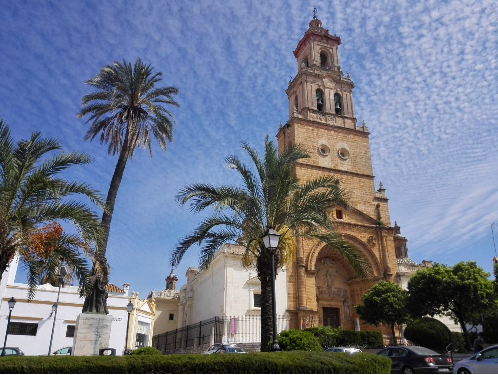
A Gothic church from the late 13th century, defensive in nature, located near the Castle.
It has three naves completed with a Renaissance dome and Baroque and Neoclassical chapels.
You cannot pass through here without visiting its crypt and its famous “mummies.”
 Pasaje del Niño Perdido — a must-see in Utrera
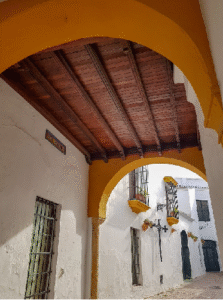
Not to be missed in Utrera’s historic centre, this very charming corner is located in Utrera’s former Jewish quarter. What was once a gate through the walls is today a whitewashed arch leading you into an alley lined with flowerpots in the white and yellow earth tones so characteristic of Seville’s streets.
Utrera Town Hall
Without a doubt, one of the most curious and surprising we have ever seen.
It was once the Palace of the Counts of Vistahermosa, which is why it looks nothing like the typical idea of a town hall.
The Vistahermosa family—creators of the bloodline from which 99% of today’s fighting bull stock descends—acquired the residence in the 18th century; its Rococo façade still remains. In the 19th century it was sold to the Cuadra Family, who added the most luxurious gardens and halls, notably the Arab, Chinese, Pompeian, and German Renaissance rooms.
Sanctuary of the Virgen de Consolación
Located on the outskirts of the city, it is reached via a spacious path flanked by Consolación Park. It has always been tied to pilgrimage, as it houses the miraculous image of Our Lady of Consolation, patron saint of Utrera.
It features decoration of a Moorish character, paradoxically alternating Marian emblems and Christian inscriptions.
These were the kinds of dedications made by sailors. The Virgin holds a little boat in her hand and is known as “the one with the little boat in her hand,” linked to the maritime tradition of blessings from those travelling to the Americas.
There is a room filled with ex-votos, paintings depicting the various miracles people attributed to the Virgin—if you take a moment to look, you will find them fascinating.
Another curiosity: if you want to see the Virgin up close, you can climb the side stairs to the small chamber where the image is kept and circle around it.
Utrera’s Pastry Shops
Famous for its sweets, the town has nearly ten confectioneries and patisseries. The (very logical and interesting) reason they gave us is that when, at the end of the 19th century, the town was an important railway hub, people visiting relatives would bring a box of sweets—hence the great variety.
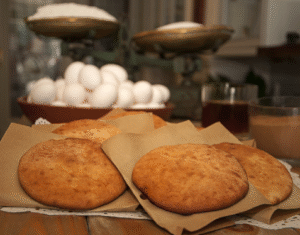
And if you have a sweet tooth, you simply cannot leave without trying the most famous: the mostachón de Utrera, of Arab origin. It is a sponge made with flour, egg, cinnamon, sugar, and honey, with no preservatives or colourings. It sticks to the paper on which it is baked and comes in both white sugar and cane sugar varieties.
Bell Ringers of Utrera
For more than 500 years, Utrera’s bell ringers have been masters at sounding the noble bronze bells of the town. The traditional style of ringing the bells, both the fixed ones and those that can be turned over, does not differ too much from that used in other Andalusian bell towers. However, their bravery and skill in jumping over them and balancing them make this unique tradition a candidate for UNESCO Intangible Cultural Heritage status.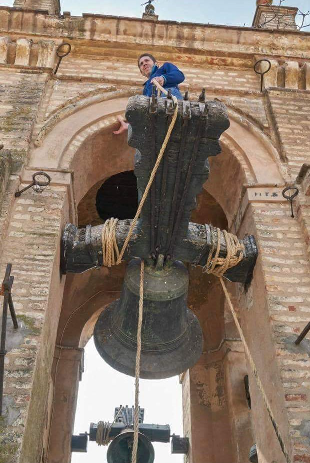
Where to stay in Utrera
If you want to stay in Utrera, here are some lodging options:
- Hotel Veracruz: “Very charming, spacious and well-decorated rooms, very clean, and above all, extremely friendly staff.”
- Hotel AMR: “A central hotel offering meeting rooms with projector, bar service, and breakfasts.”
- Hospedería Santa Clara: “A house located right in the historic centre of Utrera, exquisitely decorated, combining tradition and modernity.”
- Hotel Palacio San Fernando: “Three-star hotel located in an 18th-century palace house, offering exclusivity, excellent service, and warmth in every corner.”
- Casa Campón: “A very clean, centrally located house, very well equipped: with dishwasher, washing machine, coffee maker… Very comfortable bed.”
Top 10 places to visit in Seville
Seville could be described as a grand city. The architects of its cathedral are famed to have said “Let’s build
Hidden gems in Seville: off the tourist track
Seville, the sun-drenched capital of Andalucía, is famed for its flamenco, tapas, and stunning Moorish architecture. While landmarks like the
10 day trips from Seville you should not miss
A visit to the city of Seville offers plenty to see, but if you have more than a few days
The vibrant fiestas of Seville: culture, tradition & joy
What truly sets Seville apart are its vibrant fiestas. These celebrations, deeply rooted in tradition, offer visitors a unique glimpse